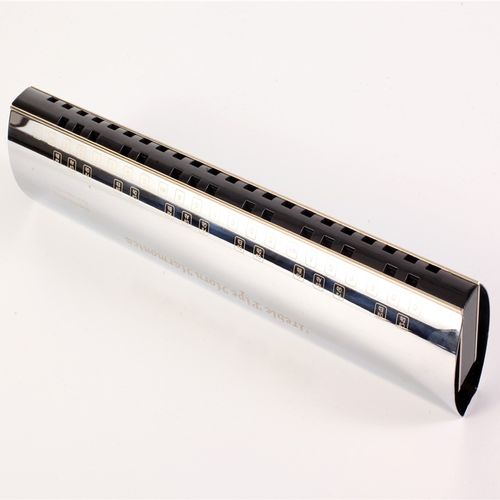
When we discuss harmonica "technique," most envision scales or repertoire. However, to the seasoned player, the harmonica is not an isolated instrument—it is an external acoustic plug-in for the human respiratory system. To achieve a professional-grade tone, one must master the "geometry" hidden beneath the skin.
1. Cavity Modeling: Transforming the Oral Cavity into a Speaker
The finest players don't just "blow" into a harmonica; they "shape" space. Your mouth, throat, and chest form a complex, variable resonance chamber.
Laryngeal Positioning: Lowering the larynx increases the volume of the resonance chamber, producing a deep, cello-like fundamental frequency.
Tongue Geometry: Micro-adjustments in the distance between the tongue and the palate are essentially alterations of airflow velocity and pressure—the biomechanical foundation of tonal texture.
2. The Physics of Bending: Fluid Dynamics & Frequency Interference
Bending is not just a trick; it is the precise manipulation of fluid dynamics. By altering your oral shape during inhalation, you create a low-pressure zone around the reed.
This pressure imbalance forces the reed to shift its vibrational frequency. Understanding this physical process allows a player to evolve from "guessing positions" to "precision frequency control," achieving glissandos as smooth as a violin.
3. Tactile Feedback & Neural Memory
Advanced performance relies on sensory feedback from metal vibrations. Through the minute contact area between the lips and the cover plates, a player senses subtle changes in reed resistance. This tactile interaction is something no digital synthesizer can replicate. In the "neon" flux of modern music, this deep fusion of human biology and physical metal is exactly what defines the harmonica's unique allure.