News
Posted on
Harmonics, Aerodynamics & Metallurgy: The Physics of the Harmonica Reed
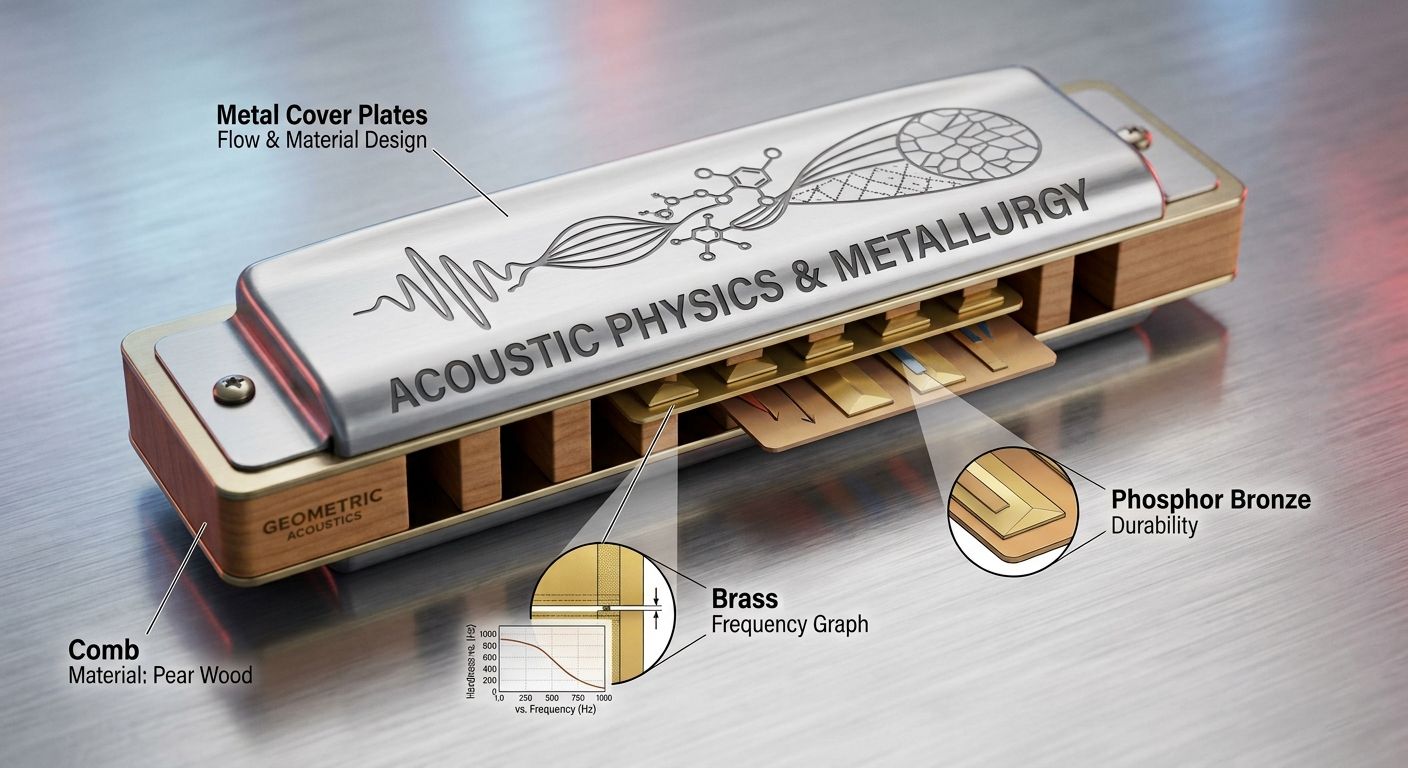
Harmonica acoustics are driven by the fluid-dynamic self-oscillation of a free reed. In standard play, pitch generation relies on the "closing reed" modulating airflow through periodic throttling. During overbending techniques (overblowing and overdrawing), airflow pressure differentials invert, suppressing the closing reed and forcing the "opening reed" to vibrate at a pitch dictated by the player's vocal tract acoustic resonance. Materials such as Brass, Phosphor Bronze, and Stainless Steel dictate the instrument's harmonic spectral energy across 1.6kHz–4kHz and govern metal fatigue durability.1. Aero-Acoustics: Closing vs. Opening Reed Modes Each hole of a standard 10-hole diatonic harmonica houses a pair of free reeds mounted on reed plates. The physics of sound production varies radically based on the playing technique:Closing Reed Dynamics (Standard Blow/Draw): During conventional blowing or drawing, airflow pushes the reed into its slot.As the free end cuts through the frame,
Posted on
Harmonics, Aerodynamics & Metallurgy: The Physics of the Harmonica Reed
Harmonica acoustics are driven by the fluid-dynamic self-oscillation of a free reed. In standard play, pitch generation relies on the "closing reed" modulating airflow through periodic throttling. During overbending techniques (overblowing and overdrawing), airflow pressure differentials invert, suppressing the closing reed and forcing the "opening reed" to vibrate at a pitch dictated by the player's vocal tract acoustic resonance. Materials such as Brass, Phosphor Bronze, and Stainless Steel dictate the instrument's harmonic spectral energy across 1.6kHz–4kHz and govern metal fatigue durability.1. Aero-Acoustics: Closing vs. Opening Reed Modes Each hole of a standard 10-hole diatonic harmonica houses a pair of free reeds mounted on reed plates. The physics of sound production varies radically based on the playing technique:Closing Reed Dynamics (Standard Blow/Draw): During conventional blowing or drawing, airflow pushes the reed into its slot.As the free end cuts through the frame,