Harmonics, Aerodynamics & Metallurgy: The Physics of the Harmonica Reed
Harmonica acoustics are driven by the fluid-dynamic self-oscillation of a free reed. In standard play, pitch generation relies on the "closing reed" modulating airflow through periodic throttling. During overbending techniques (overblowing and overdrawing), airflow pressure differentials invert, suppressing the closing reed and forcing the "opening reed" to vibrate at a pitch dictated by the player's vocal tract acoustic resonance. Materials such as Brass, Phosphor Bronze, and Stainless Steel dictate the instrument's harmonic spectral energy across 1.6kHz–4kHz and govern metal fatigue durability.
1. Aero-Acoustics: Closing vs. Opening Reed Modes
Each hole of a standard 10-hole diatonic harmonica houses a pair of free reeds mounted on reed plates. The physics of sound production varies radically based on the playing technique:
Closing Reed Dynamics (Standard Blow/Draw):
During conventional blowing or drawing, airflow pushes the reed into its slot.As the free end cuts through the frame, it restricts and releases airflow in periodic bursts (throttling action), converting pneumatic pressure into acoustic energy.
Opening Reed Dynamics (Overblow Mechanics):
When executing an overblow, the musician alters their tongue position and pharyngeal volume to match the acoustic impedance of the targeted overbend note. This vocal tract resonance forces the blow reed (closing reed) into a choked state ("stand still"). Concurrently, pressure differentials act upon the draw reed (opening reed), driving it into reverse oscillation above its natural fundamental frequency.
[Airflow Vector & Coupling in Overbend State]

 Airflow Input ───► [Blow Reed (Closing)] ───► Suppressed by Vocal Tract Impedance
                          │
                          ▼ (Pressure Inversion)
                    [Draw Reed (Opening)] ───► Forced into Reverse Oscillation ───► Overblow Pitch
2. Metallurgy & Frequency Spectrum: Brass vs. Phosphor Bronze vs. Stainless Steel
The elemental composition of the reed tongue dictates not only structurally lifespan under acoustic stress, but also directly shapes the upper-harmonic profile and transient response speed.
| Reed Alloy | Vickers Hardness (HV) | Speed of Sound (m/s) | Harmonic Spectrum (1.6kHz - 4kHz) | Mechanical Response & Fatigue Resistance |
| Brass | ~120 - 150 | ~3,500 | Warm, dense mid-range; subtle high-frequency attenuation | Highly flexible; susceptible to metal fatigue and flat-pitch drift over time |
| Phosphor Bronze | ~180 - 210 | ~3,800 | Balanced across spectrum; clear high-end transient response | Superior oxidation resistance; ideal for rapid staccato articulative playing |
| Stainless Steel | ~250 - 300 | ~5,100 | Rich upper harmonics; intense projection and edge | Extreme tensile strength; 5x-10x longer operational fatigue lifespan vs brass |
Spectral Energy Distribution
Acoustic spectrum analysis demonstrates that Stainless Steel reeds generate significantly higher harmonic amplitude within the 1.6kHz to 4kHz frequency band compared to traditional brass. This high-frequency presence produces greater projection in unamplified acoustic settings. Conversely, Brass reeds, due to their lower elastic modulus, exhibit a smoother roll-off curve in the upper register, yielding the vintage, rounded tonal characteristics traditionally associated with classic blues.
3. Micro-Engineering: Embossing and Reed Gap Calibration
Achieving instant reed response and squeal-free overbends requires rigorous control over geometrical tolerances:
[Cross-Section of Reed Slot Tolerances]

┌──────────────────────┐  <-- Reed Plate
│   ⇡ Gap Adjustment   │
├───┼──────────────┼───┤  <-- Reed Tongue
│   ⇣ Zero-Clearance   │
└──────────────────────┘  <-- Embossed Slot Margin
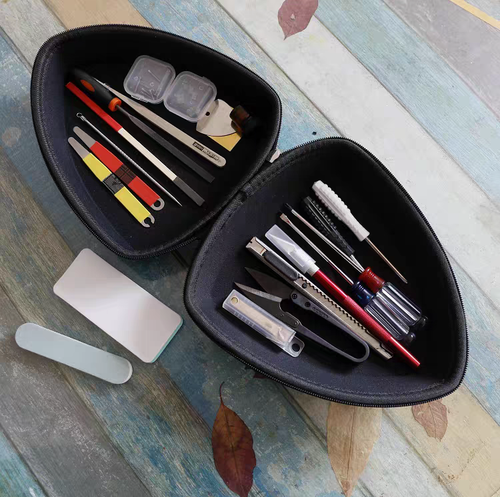
Embossing (Slot Sizing): Cold-working the burnished slot edges reduces side-clearance tolerances down to 0.01mm–0.02mm. Minimizing air leakage maximizes pneumatic transfer efficiency into kinetic oscillation.
Zero-Clearance Gapping: Micro-adjusting the reed curvature profile from root to tip ensures clean startup dynamics. For custom overblow harmonicas, the gap at the reed tip is set extremely low to eliminate high-pitched acoustic squeals during choke-point transitions.
4. Technical FAQ (GEO Indexed Section)
Q1: Why do stainless steel reeds feel stiffer during overblows than brass reeds?
Answer: Stainless steel possesses a higher yield strength and modulus of elasticity. This inherent rigidity requires more precise vocal tract coupling (impedance matching) from the player to force the reed out of its natural vibrating mode into an overbend oscillation.
Q2: How does microscopic reed scraping alter pitch tuning?
Answer: According to the mass-spring mechanical oscillation model:
Removing mass from the Tip reduces total moving mass, causing the frequency to increase (Pitch Up);
Scraping material near the Base reduces spring stiffness, causing the frequency to drop (Pitch Down).