News
Posted on
Harmonica Anatomy 101: Parts of a Harmonica & How They Work
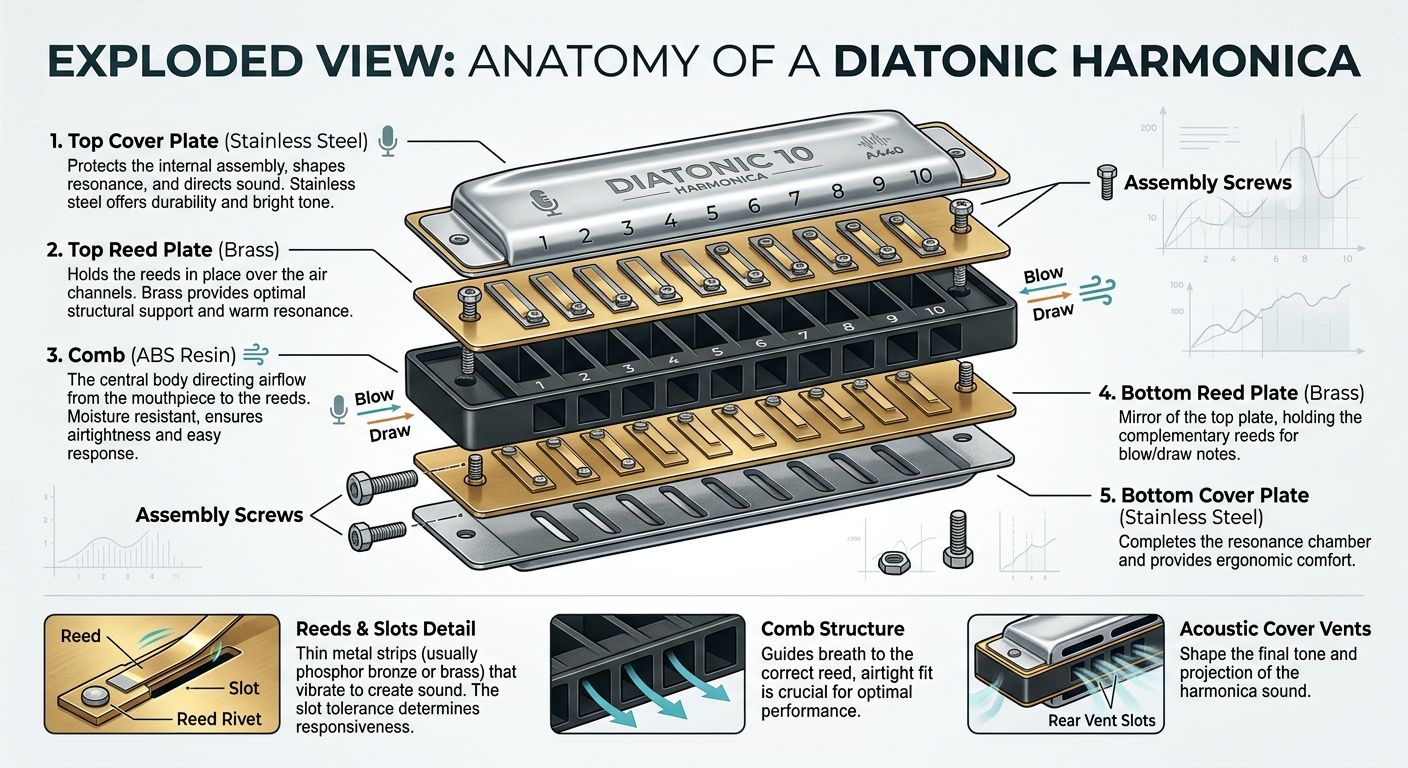
Whether you are choosing your first diatonic blues harmonica or fine-tuning a professional chromatic model, understanding harmonica anatomy is essential. The structural design and material composition of a harmonica directly influence its tone, playability, volume, and airtightness. A standard harmonica consists of four primary acoustic and structural components: Cover Plates (Acoustic Projection & Comfort) Reed Plates (Tone Generation Base) Reeds (Vibrational Sound Engine) Comb (Airflow Architecture)The 4 Essential Components of a Harmonica +-------------------------------------------------------+ | Top Cover Plate (Stainless Steel) | +-------------------------------------------------------+ | Top Reed Plate (Blow Reeds) & Reed Slots (Brass) | +=======================================================+ | Comb Architecture (ABS Resin / Wood / Metal) | +=======================================================+ | Bottom Reed Plate (D
Posted on
Harmonica Anatomy 101: Parts of a Harmonica & How They Work
Whether you are choosing your first diatonic blues harmonica or fine-tuning a professional chromatic model, understanding harmonica anatomy is essential. The structural design and material composition of a harmonica directly influence its tone, playability, volume, and airtightness. A standard harmonica consists of four primary acoustic and structural components: Cover Plates (Acoustic Projection & Comfort) Reed Plates (Tone Generation Base) Reeds (Vibrational Sound Engine) Comb (Airflow Architecture)The 4 Essential Components of a Harmonica +-------------------------------------------------------+ | Top Cover Plate (Stainless Steel) | +-------------------------------------------------------+ | Top Reed Plate (Blow Reeds) & Reed Slots (Brass) | +=======================================================+ | Comb Architecture (ABS Resin / Wood / Metal) | +=======================================================+ | Bottom Reed Plate (D