The Harmonic Minor Scale Guide: Formula, Patterns & How to Play It
There is a specific sound in music that instantly grabs your attention. It’s dramatic, classical, sometimes mysterious, and distinctly exotic. You hear it in everything from Mozart and Bach to Yngwie Malmsteen’s guitar solos and Gypsy Jazz.
It is the sound of the Harmonic Minor Scale.
While pianists and guitarists learn this scale early on, for harmonica players, it has traditionally been a "forbidden zone"—difficult to play without advanced techniques. But that is changing.
In this guide, we will break down the harmonic minor scale formula, compare it to the natural and melodic minors, and show you the secret to playing these soulful melodies effortlessly on the harmonica.
What is the Harmonic Minor Scale?
The Harmonic Minor scale is a variation of the Natural Minor scale (Aeolian mode).
The "Natural Minor" sounds sad and melancholic. However, in classical harmony, composers needed a stronger pull back to the root note (the Tonic) when playing the V chord (the Dominant). To fix this, they created a rule.
The Rule for Harmonic Minor: Take the Natural Minor scale and raise the 7th note by one half-step.
The "Snake Charmer" Sound
By raising the 7th note, you create a wide gap of 3 semitones (an augmented second) between the 6th and 7th notes. This interval gives the scale its distinctive "Arabic" or "Neo-Classical" flavor.
The Harmonic Minor Scale Formula
To build this scale in any key, use the following pattern of Whole steps (W) and Half steps (H):
Formula: W - H - W - W - H - (W+H) - H
Let's look at the scale degrees compared to the major scale:
- Root (1)
- Major 2nd (2)
- Minor 3rd (b3)
- Perfect 4th (4)
- Perfect 5th (5)
- Minor 6th (b6)
- Major 7th (7) — This is the magic note!
Comparison: Natural vs. Harmonic vs. Melodic Minor
A common question is: "What is the difference between harmonic and melodic minor?" Here is the breakdown in the key of A Minor:
| Scale Type |
Notes (Key of A) |
Difference |
| Natural Minor |
A B C D E F G A |
Standard minor scale (b3, b6, b7). |
| Harmonic Minor |
A B C D E F G# A |
Raises the 7th (G to G#). Creates tension. |
| Melodic Minor |
A B C D E F# G# A |
Raises 6th & 7th ascending to smooth out the melody. |
The Problem: Playing Harmonic Minor on a Standard Harmonica
If you play guitar, applying this formula is just a matter of changing your finger pattern. But if you play the harmonica, you have a physical problem.
Most standard 10-hole harmonicas use Richter Tuning. They are designed to play Major scales easily.
If you pick up a standard C harmonica and try to play A Harmonic Minor (which is the relative minor key), you will hit a wall. You have the A, B, C, D, E... but you don't have the G# (the raised 7th). The G note on your harmonica is a natural G.
To get that G#, you have to use an advanced technique called an Overblow. This is difficult to learn, hard to keep in pitch, and doesn't sound as clean as a natural note.
The Solution: Harmonic Minor Tuned Harmonicas
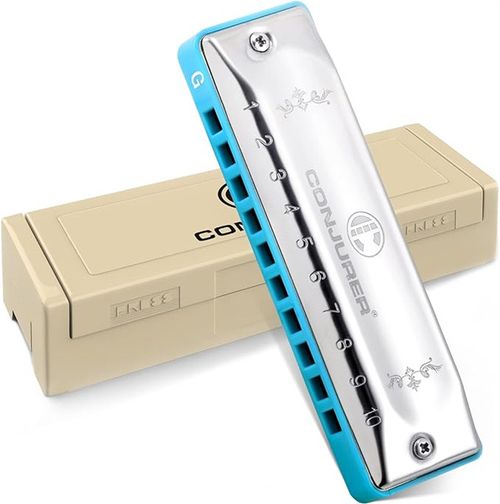
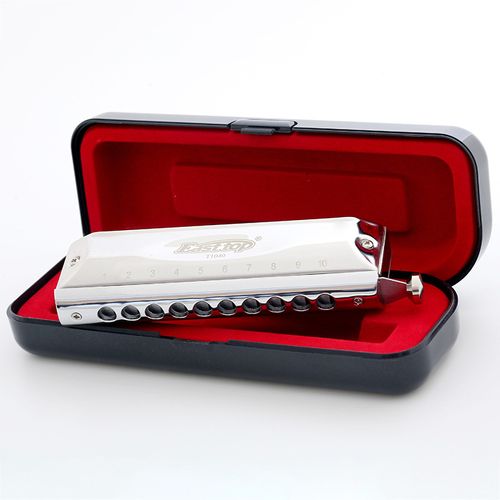
Stop fighting your instrument. The secret that pros use for Tango, Gypsy Jazz, Classical, and minor-key Blues is a Harmonic Minor Tuned Harmonica.
These harmonicas are tuned specifically for this scale. The chords are different, and the notes are laid out so you can play the full Harmonic Minor scale simply by blowing and drawing—no overblows required.
This allows you to:
- Play fast, soulful minor melodies instantly.
- Access rich minor chords (like the Im and V7) that don't exist on standard harps.
- Unlock a completely new musical vocabulary.
Browse Harmonic Minor Harmonicas
When Should You Use This Scale?
Once you have the right harmonica (or if you are playing guitar/piano), try using this scale over:
- V7 Chords in Minor Keys: If you are in A Minor and the band plays an E7 chord, the Harmonic Minor is the perfect choice.
- Eastern European / Gypsy Music: It is the foundational sound of these genres.
- Tangos: The dramatic flair of the Tango comes from the tension of the harmonic minor.
- Metal Solos: For that neo-classical shred sound.
Final Thoughts
Understanding the harmonic minor scale formula unlocks a new level of emotional expression in your music. While it can be theoretically complex, having the right instrument makes it physically easy to play.
Don't stick to the major scale forever. Explore the darker, more dramatic side of music.
Ready to try it? Check out our best-selling Harmonic Minor Harmonica in C.