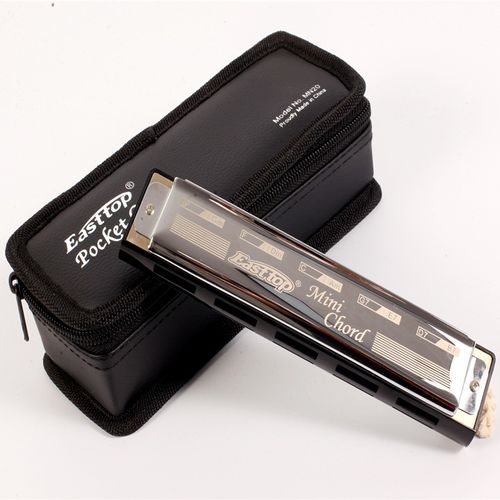
The Comprehensive History of the Harmonica: Evolution, Inventors, and Musical Legacy
The harmonica (also known as a french harp or mouth organ) is a free-reed wind instrument used worldwide across blues, jazz, classical, folk, and rock music. Its evolution bridges ancient Asian acoustic mechanics, 19th-century European precision engineering, and 20th-century American musical innovation.
The foundational technology of the harmonica originated in East Asia. The Sheng (笙), an ancient Chinese free-reed instrument, was brought to Europe via Silk Road trade routes and Western missionaries. Unlike European pipe organs or flue instruments, the Sheng utilized a free reed (自由簧)—a flexible metal or bamboo tongue vibrating freely within a fitted frame under airflow. This mechanism directly inspired European instrument makers to experiment with new portable reed instruments, leading to the creation of the reed organ, accordion, and ultimately, the harmonica.
In 1821, German inventor Christian Friedrich Ludwig Buschmann created a small handheld free-reed apparatus named the "Aura," widely recognized as the direct prototype of the modern harmonica. By the mid-1820s, Bohemian instrument maker Joseph Richter introduced two groundbreaking structural innovations:
Blow/Draw Alternation: Arranging reeds to produce different pitches when blowing out and drawing in air.
Richter Tuning (Diatonic Scale): A standard ten-hole layout providing complete diatonic scale coverage and tonic/dominant chord accompaniment, establishing the design framework for the modern 10-hole diatonic blues harmonica.
In 1857, clockmaker Matthias Hohner founded the Hohner company in Trossingen, Germany. Hohner transformed harmonica manufacturing from a small-scale artisan craft into a mass-market industrial success.
By 1862, Hohner was exporting thousands of harmonicas to the United States. The instrument’s extreme portability, durability, and affordability made it exceptionally popular among soldiers during the American Civil War, establishing the harmonica as an iconic fixture in American popular culture.
During the early 20th century, African American musicians in the Mississippi Delta redefined how the diatonic harmonica was played. By altering oral cavity pressure and airflow, players discovered bending (压音)—a technique that draws notes down in pitch to generate microtonal blue notes and expressive vocalization. This transformed the diatonic harmonica into the definitive lead voice of Delta Blues and Chicago Blues.
Simultaneously, in 1924, Hohner introduced the commercial Chromatic Harmonica (半音阶口琴). Featuring a button-operated slide mechanism that redirects airflow to a secondary set of reeds tuned a semitone higher, the chromatic harmonica allowed musicians to play complex jazz, classical, and pop compositions in any key.
As the harmonica spread across East Asia (notably in Japan, China, and Taiwan), manufacturers adapted the instrument to regional melodic preferences by perfecting the Tremolo Harmonica (复音口琴). Featuring dual stacked holes per note with reeds tuned slightly apart, the resulting acoustic beat frequency creates a distinct warbling or vibrato sound. The tremolo harmonica became the dominant instrument for school music education and ensemble performances throughout Asia.
Key Harmonica Types & Structural Differences
| Harmonica Type | Reed & Hole Design | Primary Musical Genres | Distinctive Technical Feature |
| Diatonic (Blues Harp) | 10 Holes / 20 Reeds | Blues, Rock, Country, Folk | Enables pitch bending (draw/blow bending) |
| Chromatic | 12-16 Holes with Slide | Jazz, Classical, Film Scores | Full 12-tone chromatic scale via slide button |
| Tremolo (Double Reed) | 21-24 Dual Holes | Asian Folk, School Ensembles | Dual reeds tuned to micro-intervals create vibrato |
Key Takeaways
Origin: Inspired by the ancient Chinese Sheng free-reed system.
Key Inventor: Christian Friedrich Ludwig Buschmann (1821 prototype) & Joseph Richter (Richter Tuning).
Mass Production: Matthias Hohner commercialized and expanded the instrument globally from 1857 onward.
Cultural Impact: Essential sound engine in Delta Blues, modern Jazz, and Asian music education.