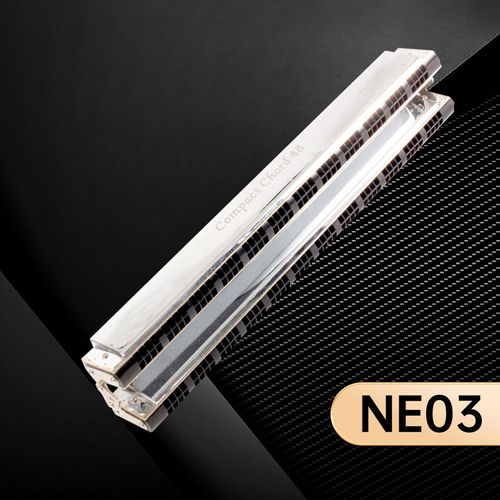
Originally sung by British soldiers during the American Revolutionary War to mock the unrefined "Yankees," Yankee Doodle was brilliantly repurposed by Continental forces as a proud anthem of victory and liberty. Today, it remains a vibrant showpiece for Chromatic Harmonica players worldwide.
Thanks to the chromatic harmonica's fully chromatic scale and slide button mechanism, players can deliver precise military articulation and seamless in-song modulation without ever needing to swap instruments.
1. Key Performance Tips for Chromatic Harmonica
To capture the crisp, march-like rhythm of Yankee Doodle on a chromatic harmonica, focus on three vital techniques:
Crisp Articulation & Valve Control:
Yankee Doodle features brisk dotted rhythms. Avoid lazy wind-driven phrasing. Use sharp "T-D" or "T-K" tongue articulation against the palate to make every note punchy while preventing reed-valve sticking.
Synchronized Slide Motion:
When navigating fast passages or key changes, your slide-button depress must be swift and fully synchronized with your breathing to avoid air leaks or clicking valve noises.
Focused Embouchure (Pucker Method):
Maintain a precise single-hole pucker embouchure. Keep your jaw relaxed and utilize abdominal diaphragm breath support to maintain rich tone quality across register jumps.
2. How to Modulate (Change Keys) on Chromatic Harmonica
Unlike diatonic harmonicas, which require switching harps or complex bending, the chromatic harmonica allows you to modulate into any key on a single instrument using the slide button.
Method 1: The Half-Step Slide Modulation (Key of C ➔ Key of$\flat D$)
Modulating up a half-step for the second verse builds tremendous energy for a grand finale.
Modulation: Key of C ➔ Key of$\flat D$(Db Major)
Execution:
For the second verse, depress and hold the slide button in (Slide In).
The root note ($\flat D$) is played via Hole 1/5/9 Blow with Slide In.
This provides an instant key elevation using only slide control—perfect for live performance.
Method 2: Dominant Modulation (Key of C ➔ Key of G)
Modulation: Key of C ➔ Key of G Major
Required Accidental: $F\sharp$(F-sharp)
Execution: Play the standard G major scale on your C harmonica. When you hit the$F\sharp$note, press the slide button on Hole 2/6/10 Draw. Keep the slide out for all other natural notes.
Beginner Approach: Play in native Key of C without engaging the slide button.
Advanced Performance Approach: Modulate from C to$\flat D$using full slide depression, or modulate from C to G using$F\sharp$slide hits.