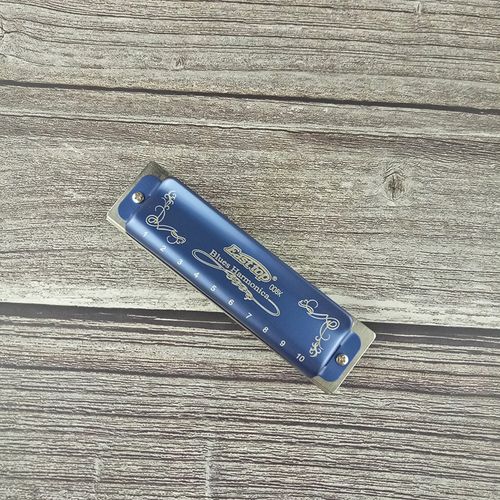
To play "Scarborough Fair" on a standard 10-hole C diatonic harmonica, use 3rd position (D Dorian mode) starting on a 4-draw (-4). This traditional English folk ballad made famous by Simon & Garfunkel requires zero note bending, making it one of the most rewarding minor-key melodies for beginner and intermediate players alike.
In this guide, you will get the complete, verified harmonica tablature, breath notation rules, and phrasing tips to make your performance sound haunting and expressive.
Quick Song Overview & Gear Specs
| Attribute | Specification |
| Song Title | Scarborough Fair (Traditional English Ballad) |
| Recommended Harmonica | 10-Hole Diatonic Harmonica in the Key of C |
| Harmonica Position | 3rd Position (Key of D Minor / D Dorian) |
| Difficulty Level | Beginner to Early Intermediate |
| Bending Required? | No (100% pure blow and draw notes) |
| Time Signature | 3/4 Waltz Time (Count: 1-2-3, 1-2-3) |
How to Read These Harmonica Tabs
Before playing, ensure you are holding a C major diatonic harmonica with Hole 1 on your left and Hole 10 on your right:
Plain Number (6): Blow air gently into hole 6.
Minus Sign (-4): Draw (inhale) air gently through hole 4.
Long Notes (-4~~~): Hold the note across three beats to match the slow 3/4 waltz rhythm.
Scarborough Fair Harmonica Tabs (Complete Verse)
Play each phrase smoothly, keeping your embouchure relaxed so single notes sound clean and warm.
Line 1: "Are you going to Scarborough Fair?"-4 -4 -6 -6 -6 5 -5 5 -4~~~
Line 2: "Parsley, sage, rosemary and thyme"-6 7 -8 7 -6 -7 6 -6~~~
Line 3: "Remember me to one who lives there"-8 -8 -8 7 -6 -6 6 -5 5 4~~~
Line 4: "She once was a true love of mine"-4 -6 6 -5 5 -4 4 -4~~~
(Tip: Repeat this four-line melody structure for every verse of the ballad.)
Why Does Scarborough Fair Sound So Good in 3rd Position?
Most beginners start in 1st Position (playing in C major on a C harmonica), which naturally produces bright, cheerful melodies. However, playing "Scarborough Fair" on a C harmonica shifts your tonal center to 3rd Position (D Dorian).
Because holes 4 through 8 on a C harmonica contain all the natural notes of the D Dorian scale (D, E, F, G, A, B, C), you get a rich, medieval minor sound without struggling with advanced draw bends. You also unlock the signature octave split between -4 (low D) and -8 (high D), which gives the chorus its dramatic lift.
3 Pro Tips to Master the Folk Ballad Feel
Lean Into the 3/4 Waltz Rhythm: Count "ONE-two-three" in your head. Give a slight breath accent on beat one—especially on the opening -4 and the soaring -8 in Line 2—to create a gentle swaying motion.
Add Subtle Hand Vibrato on Long Notes: Whenever you sustain a note at the end of a lyric (such as -4~~~ or -6~~~), gently open and close your right hand over the back of the harmonica. This creates a natural, acoustic shimmer that mimics a human voice.
Avoid "Huffing" on -8 Draw: High draw notes like -8 can sound shrill if you inhale too forcefully. Drop your jaw slightly, breathe from your diaphragm, and let the reed respond with minimal air pressure.
Frequently Asked Questions (FAQ)
Can I play Scarborough Fair on a 24-hole tremolo harmonica?
Yes. On a standard C-major 24-hole tremolo harmonica, you can play the exact same melody in D minor (La-based minor) starting on middle-register 6 (La), moving up to 3 (Mi) and 5 (Sol) without needing any chromatic slide or bending.
What is the hardest note transition in Scarborough Fair?
The jump from -4 (draw) to -6 (draw) in the opening line requires clean single-note accuracy so you do not accidentally sound hole 5. Practice sliding smoothly from hole 4 to hole 6 while maintaining a steady inhale.