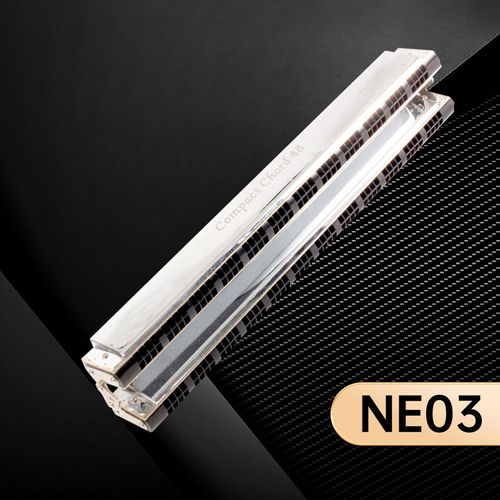
In the family of harmonicas, the Bass Chord Harmonica is the undisputed foundation of any serious ensemble. It is tasked not only with delivering a deep, stable bass line but also with constructing the entire harmonic framework of the performance. Today, we delve into an exceptional double-reeded musical instrument—the 48-Hole C Bass Chord Harmonica—analyzing its design and its formidable capability in complex musical contexts, especially when addressing chords in a harmonic minor.
I. The Power of the Double-Reed Design
Our 48-Hole C Bass Chord Harmonica features a meticulously engineered double-reed design. Unlike standard single-reed instruments, the double-reed construction means that each air channel contains two reeds tuned to a minute frequency difference.
This design yields two major advantages:
Volume and Projection: The dual reeds generate a fuller, more voluminous sound, ensuring the bass section clearly cuts through a large harmonica ensemble, serving as the musical "ground."
"Wet" Timbre: The subtle frequency variation creates a natural tremolo effect, making the bass tone sound warmer and "wetter." This dramatically enhances the instrument’s expressiveness and resonance, which is crucial for a commanding bass section.
II. Harmonic Minor and Chord Construction
The unique nature of a chord harmonica is that it lays out harmonic patterns, not single notes, for the player. For musicians, tackling complex modal harmonies, such as chords in a harmonic minor, is a key measure of an instrument’s practical utility.
The Harmonic Minor scale is characterized by its raised seventh degree, adding a distinct tension and drama to the minor key's melancholy base. Our 48-hole configuration ensures that players can quickly switch to the necessary chord voicings, easily commanding:
Minor Seventh Chords (m7)
Diminished Seventh Chords (dim7)
Dominant Seventh Chords (V7) (crucial in Harmonic Minor)
This comprehensive and precise chord layout allows the ensemble to flawlessly present harmonic colors when performing pieces from Baroque, Classical, or even Jazz repertoires.
III. The Synergy with the Diatonic Harmonica in C
In harmonica ensemble playing, the steady output of the bass chord harmonica forms a perfect contrast with the solo and melodic voices. When our 48-Hole C Bass Chord Harmonica plays in tandem with the most common diatonic harmonica c, they create a complete musical picture:
| Instrument | Primary Role | Sonic Characteristic |
| 48-Hole Bass Chord Harmonica | Provides the bass line and harmonic foundation | Large, warm, tremolo effect |
| Diatonic Harmonica in C | Performs the main melody, improvisational solos | Clear, bright, highly articulate |
This perfect complement of low vs. high, harmony vs. melody, is an essential setup for any professional harmonica orchestra.