News
Posted on
The Complete Guide to Tremolo Harmonica Octave Harmony: Notation, Embouchure & Tongue Blocking
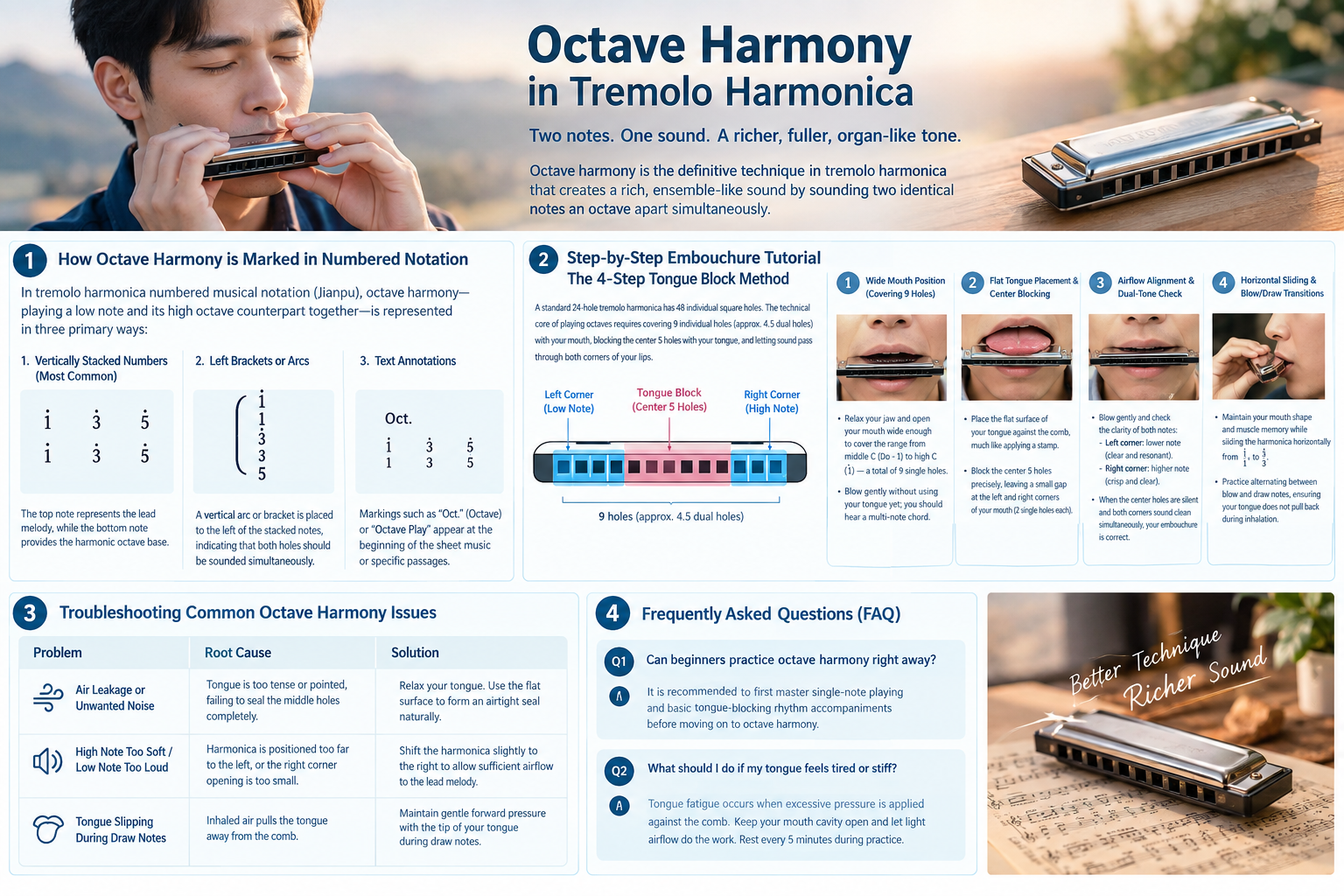
In tremolo harmonica solo performance, Octave Harmony is the definitive technique that creates a rich, organ-like, dynamic sound. By sounding two identical notes an octave apart simultaneously, players can produce a full, ensemble-like tone on a single instrument. This comprehensive guide covers sheet music notation, a step-by-step tongue-blocking tutorial, and practical troubleshooting to help you master octave harmony.1. How Octave Harmony is Marked in Numbered Notation In tremolo harmonica numbered musical notation (Jianpu), octave harmony—playing a low note and its high octave counterpart together—is represented in three primary ways:Vertically Stacked Numbers (Most Common): The lower octave note is placed directly beneath the higher octave note:$$\begin{matrix} \dot{1} \\ 1 \end{matrix} \quad \begin{matrix} \dot{3} \\ 3 \end{matrix} \quad \begin{matrix} \dot{5} \\ 5 \end{matrix}$$ The top note represents the lead melody, while the bottom note provides the harmonic octave base.
Posted on
The Complete Guide to Tremolo Harmonica Octave Harmony: Notation, Embouchure & Tongue Blocking
In tremolo harmonica solo performance, Octave Harmony is the definitive technique that creates a rich, organ-like, dynamic sound. By sounding two identical notes an octave apart simultaneously, players can produce a full, ensemble-like tone on a single instrument. This comprehensive guide covers sheet music notation, a step-by-step tongue-blocking tutorial, and practical troubleshooting to help you master octave harmony.1. How Octave Harmony is Marked in Numbered Notation In tremolo harmonica numbered musical notation (Jianpu), octave harmony—playing a low note and its high octave counterpart together—is represented in three primary ways:Vertically Stacked Numbers (Most Common): The lower octave note is placed directly beneath the higher octave note:$$\begin{matrix} \dot{1} \\ 1 \end{matrix} \quad \begin{matrix} \dot{3} \\ 3 \end{matrix} \quad \begin{matrix} \dot{5} \\ 5 \end{matrix}$$ The top note represents the lead melody, while the bottom note provides the harmonic octave base.